Physician-Led Non-Surgical Lifting & Aesthetic Medicine in Gangnam, Seoul
4.8 Google Rating (56 Reviews)
en-US

Medical Guide
InMode RF Skin Tightening: Which Handpiece, and Why
The published description says depends on the handpiece four separate times. That conditional is the most important thing on the page, and here is why.
Schedule a ConsultationInMode RF Skin Tightening: Which Handpiece, and Why
Medically reviewed by Dr. Hyunseon Kee, Director, JD Clinic
Most treatment descriptions state what a device does. This one keeps saying it depends.
Suction may be used, depending on the specific device. The treatment may be minimally invasive or non-surgical, depending on the specific technology used. Fat reduction applies for certain technologies. Bruising and other effects vary depending on the specific radiofrequency technology and treatment technique.
Four conditionals on one page. That is not vagueness. It is an accurate description of what this actually is — a family of radiofrequency technologies with different handpieces, rather than one machine that does one thing — and it changes the question you should walk in with.
Not "what does this treatment do?" but "which configuration, and why that one for me?"
What the clinic publishes
What it is. A treatment using radiofrequency energy, with suction-assisted delivery depending on the specific handpiece, to heat targeted tissue and support skin tightening and facial contouring. It may also address localized fat while promoting tissue contraction.
Who it is for. Adults with mild to moderate skin laxity or localized soft-tissue fullness who are seeking facial contouring and skin tightening.
Who it is not for. Patients with certain medical conditions, active skin infections or inflammation in the treatment area, or conditions that may increase the risk of radiofrequency treatment. Pregnancy and certain implanted electronic devices may also require avoidance or additional medical assessment.
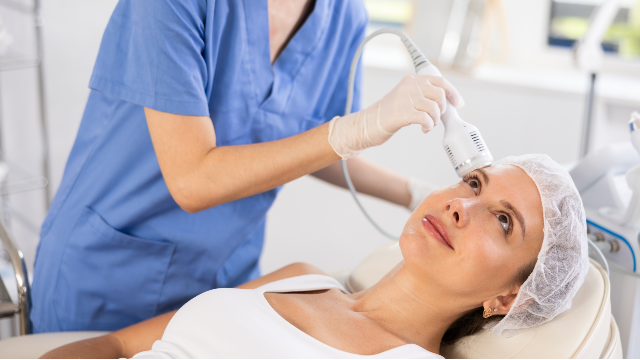
How the appointment runs. The area is examined and prepared, then may be marked according to the planned contour. The handpiece is applied — suction may be used depending on the device — and controlled energy is delivered to the targeted tissue. The area is then checked.
Anesthesia. None needed.
Afterward. Temporary bruising may occur. Depending on the technology and technique, patients may also experience temporary swelling, redness, tenderness or discomfort. Stated recovery: approximately one to three days. Avoid strenuous exercise during the recommended recovery period.
Duration. Approximately 30 to 40 minutes.
How long it holds. A stated maintenance period of approximately four to six months.
The combination that should make you read carefully
Here is something worth noticing, because it is genuinely unusual on this menu.
No anesthesia is needed. Bruising is the first named after-effect. Recovery is one to three days.
Across JD Clinic's facial treatments, those three usually travel differently. Treatments that need no anesthesia tend to name redness and warmth and describe same-day returns. Treatments that name bruising first tend to involve a needle or a thread, and they use cream or local anesthesia.
This one sits in between, and the reason is the suction. A handpiece that draws tissue in while heating it is doing something mechanical as well as thermal, and mechanical handling of tissue is what produces bruising. The National Library of Medicine's page on bruises covers what that involves and how long it takes to resolve.
None of which makes the treatment worse. It makes the recovery figure real: one to three days is a range you should plan for at its upper end, not its lower one, because bruising does not resolve on your schedule and a visible mark on the jaw or cheek is not something makeup reliably covers on day two.
Which configuration, and what that changes
You will not, and should not, choose the handpiece. But you should know that one was chosen, and what it implies.
The published description distinguishes two broad things the technology does: tissue contraction — the tightening half — and, for certain configurations, fat reduction. Those are different goals. A patient whose concern is loose skin and a patient whose concern is localized fullness are not being treated the same way even under the same treatment name.
The clinic's published consultation reflects that: the clinician assesses skin laxity, facial or body contours, localized fat, skin condition and the desired outcome, then selects the treatment area and intensity according to anatomy and goals.
So the two questions that matter are short.
Is my concern laxity, fullness, or both? That determines the configuration.
Which of those is this treatment aimed at in my case, and what is it not addressing? The second half of that question is the one that prevents disappointment, because a treatment aimed at contour will not do much for pigment or fine lines, and a treatment aimed at fullness is not a lifting treatment.
Where it sits among the clinic's radiofrequency options
JD Clinic's lifting menu contains several radiofrequency treatments, and their published maintenance figures are not the same.
| Stated maintenance | Treatment time | Anesthesia | |
|---|---|---|---|
| InMode RF Skin Tightening | About 4–6 months | About 30–40 minutes | None |
| Oligio Monopolar RF Lifting | About 6–9 months | About 40–50 minutes | Numbing cream |
| 10Therma RF Skin Tightening | 3–6 months | About 40 minutes | Anesthetic cream |
| Forma RF (neck) | About 2–3 months | About 25–30 minutes | Anesthetic cream |
Four radiofrequency treatments, four different durability figures, four different appointment shapes. The table compares what each is described as — it does not compare how well they work, because no such comparison is published and this article will not invent one.
What it does show is that "RF skin tightening" is not one product at this clinic. Which is the argument for letting the assessment choose, and the reason the clinic's published position contrasts individualized assessment with device-only selection. Its about page sets out that approach.
Four to six months, read for a traveler
A maintenance figure of four to six months is in the middle of this clinic's range — longer than its shortest lifting options, shorter than its longest.
For someone flying from the United States, the useful way to read it is as a question rather than a number: will I be able to act on this in four to six months, and what happens if not?
There are honest answers in both directions. If you travel annually, this treatment will have softened before your next visit, and that is worth knowing rather than discovering. If you are looking for something to carry you through a specific season or event, a four-to-six-month window is well matched to that.
What you should not do is assume the figure is a floor. It is a stated expectation, individual results vary, and the only version of it that applies to you comes from someone who has assessed your skin.
The exercise instruction
One published aftercare item is worth pulling out because it is easy to ignore: avoid strenuous exercise during the recommended recovery period.
Two reasons this matters more than it sounds.
It is specific to this treatment. Several of the clinic's energy treatments ask for exercise restriction on the day. This one ties it to a recovery period stated at one to three days.
Exercise and bruising interact. Increased circulation in a recently treated area is not helpful when bruising is the named after-effect.
Ask for your own number rather than assuming the upper end of the range. And if this treatment is one item on a longer plan, remember that the restrictions that apply to your week are the union of every treatment's instructions rather than this one's alone.
What is not in the record
No handpiece identification. The published description refers to the specific device and specific technology without naming which configurations are in use here. That is a direct and reasonable question for the clinic.
No manufacturer confirmation beyond the treatment name. If you arrived from content naming a company, that identification is not in this material.
No session count. Not published, consistent with an individually selected configuration.
No outcome data. No percentages, no comparison against the clinic's other radiofrequency treatments. The clinic publishes a patient review section, which is its own material.
The National Library of Medicine's guidance on evaluating health information is the right discipline for anything you find elsewhere that fills these gaps confidently, and the FDA's overview of aesthetic devices is a useful non-commercial frame for the category.
Five questions worth asking
Which configuration would you use, and what does it target? The conditionals on the page are the reason this is the first question.
Is my concern laxity, fullness, or both? It determines the answer to the first one.
How likely is bruising for my treatment, and where? A visible bruise on the jawline is a different problem from one that is covered.
How many days should I keep clear? One to three is a range. Get yours.
What would you recommend instead, and why not that? With four radiofrequency options on the same menu, the reasoning is the useful part.
One thing worth checking on the day
Small, and it costs nothing.
The published sequence includes a step that several treatments here do not have: the treatment area may be marked according to the planned contour before energy is delivered.
Marking is a planning act. It means someone decided where the treatment goes and made that decision visible before committing to it — and it gives you a thirty-second opportunity that no amount of reading beforehand can replace.
Look at the marks and ask what they represent.
Not to second-guess the plan. To confirm that one exists, that it refers to specific areas rather than a general region, and that it matches the concern you described. If the marked areas are not where you thought the conversation had landed, that is a discrepancy far more cheaply resolved before the handpiece than after.
It is also the moment to ask the question that has no good answer later: what are you deliberately not treating, and why?
The Bottom Line
- The published description is conditional in four places — suction, invasiveness, fat reduction and after-effects all depend on the configuration used, which makes "which handpiece, and why" the question to ask.
- Published figures: about 30 to 40 minutes, no anesthesia needed, a stated recovery of one to three days, and a maintenance period of about four to six months.
- Bruising is the first named after-effect despite no anesthesia being required — plan the recovery at the upper end of the range rather than the lower.
- Strenuous exercise is to be avoided during the recovery period; ask for your specific number rather than assuming.
- This clinic lists several radiofrequency treatments with different published durability; the assessment is what chooses between them.
Frequently Asked Questions
Why does the description keep saying "depending on the device"?
Because this is a family of radiofrequency technologies with different handpieces rather than a single machine. What the treatment does depends on which configuration is used.
Does it hurt?
No anesthesia is described as needed. Temporary tenderness or discomfort may occur depending on the technology and technique.
Will I bruise?
Temporary bruising is named as a possible effect. Ask the clinic how likely that is for your specific treatment and area.
How long does the appointment take?
Approximately 30 to 40 minutes, according to the clinic's published description.
How much downtime should I plan?
The stated recovery period is approximately one to three days, with strenuous exercise to be avoided during it.
How long do results last?
The clinic states a maintenance period of approximately four to six months. Individual results vary.
Can it reduce fat as well as tighten skin?
The published description says certain configurations may address localized fat while supporting tissue contraction. Whether that applies to your treatment is a consultation question.
Can I have it if I have an implanted electronic device?
Pregnancy and certain implanted electronic devices may require avoidance or additional medical assessment. Raise it with the clinic before booking.
This article is for general informational purposes and does not constitute individualized medical advice. It is not a self-diagnosis tool. Treatment results may vary depending on individual conditions, skin characteristics, and treatment plans, and whether a procedure is appropriate for you can only be determined through a consultation with a qualified dermatologist or other appropriately qualified clinician who has examined you in person.
More Articles
Continue reading our clinical guides.