Physician-Led Non-Surgical Lifting & Aesthetic Medicine in Gangnam, Seoul
4.8 Google Rating (56 Reviews)
en-US

Medical Guide
Thread Lifting at JD Clinic: What It Can and Cannot Do
The only treatment on this facial menu that uses local anesthesia and leaves something behind. What the record says, and the three things it leaves out.
Schedule a ConsultationThread Lifting at JD Clinic: What It Can and Cannot Do
Medically reviewed by Dr. Jin-Woo Doh, Representative Director, JD Clinic
Every other facial lifting treatment on this clinic's menu works by depositing energy and leaving. Thread lifting places a physical object under your skin and leaves it there.
That single structural difference explains almost everything else about it — why it uses local anesthesia rather than a numbing cream, why the effect is immediate rather than gradual, why the aftercare includes an instruction about how to sleep, and why it is the treatment in this category most often oversold in international marketing.
This article covers what JD Clinic publishes about it, and is equally careful to mark where the published record stops.
What the clinic says it is
The published description is direct: thread lifting uses special threads to provide a tightening and lifting effect to the facial contours, and may be considered by people looking for an immediate lifting effect.
That word — immediate — is the distinguishing feature. It is also where honest writing about this treatment has to start being careful, because an immediate visible change is the most persuasive thing a cosmetic treatment can offer and the easiest thing to exaggerate.
Here is the rest of the record.
Who it may suit. Adults with mild to moderate facial laxity who want improvement in sagging or facial contours. Suitability depends on skin condition, degree of laxity, and individual expectations.
Who may need to postpone or avoid it. People with certain skin infections, significant inflammation, bleeding problems, or medical conditions affecting healing. A medical assessment is needed to determine individual suitability.
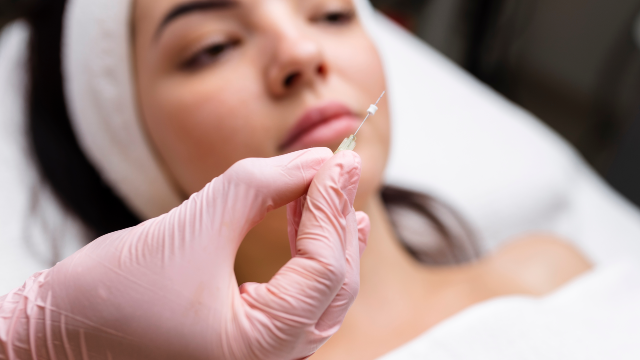
How it runs. Special threads are placed to tighten and lift the facial contours. Local anesthesia is used. The procedure takes about 30 minutes.
Afterward. Bruising and swelling may occur. The clinic advises precautions when washing the face, and instructs patients not to sleep on their stomach after treatment. Stated recovery: approximately one to two days.
How long it holds. An immediate lifting effect is described, with a stated maintenance period and retreatment cycle of six to nine months.
Local anesthesia is the tell
Across this clinic's facial lifting category, anesthetic cream is the norm. Focused ultrasound, radiofrequency, microneedling — cream, twenty minutes, then treatment. Some treatments use no anesthesia at all.
Thread lifting is the one that uses local anesthesia.
That difference is not a marketing detail. Local anesthesia is used because something is being placed, not because the clinic is being generous about comfort. It marks this as a more invasive procedure than its neighbors on the same menu, notwithstanding the word "non-surgical" that accurately describes it. The U.S. National Library of Medicine's overview of anesthesia explains the categories in plain terms.
Two practical consequences follow.
The exclusion list is about healing, not about skin. Bleeding problems and medical conditions affecting healing appear on it. That is the profile of a procedure where tissue has to recover around something, rather than one where skin has to settle after heating. If you have a bleeding disorder, take medication affecting clotting, or have a condition that slows healing, this is a conversation to start by email before you fly. Do not stop any prescribed medication on your own — that decision belongs to the clinician who prescribed it.
Bruising is named first among the after-effects. Not redness. Bruising. The National Library of Medicine's page on bruises is a reasonable primer on what that involves and how long it takes to resolve.
What "immediate" does and does not promise
An immediate lifting effect means you will see a change when you get up. It does not mean the change you see on day one is the change you will have in a week.
Bruising and swelling are both named as possible. Swelling in the days after any facial procedure can flatter or distort the result, and neither the immediate post-procedure face nor the day-three face is the finished product. The National Library of Medicine's page on edema covers what swelling is doing.
So the honest description is: an immediate mechanical change, obscured for a few days by the body's response to the procedure, then a settled result. Judging the outcome at any point in that sequence other than the end is judging something else.
The comparison the topic demands
Thread lifting is routinely marketed abroad as an alternative to a surgical facelift. JD Clinic's own published record makes no such claim, and neither does this article.
What the record supports is a much narrower comparison — against the clinic's own energy-based lifting treatments, which sit on the same menu and address an overlapping group of patients.
| Thread lifting | Energy-based lifting at this clinic | |
|---|---|---|
| Mechanism | Threads placed to tighten and lift contours | Ultrasound or radiofrequency energy delivered to tissue |
| Anesthesia | Local anesthesia | Anesthetic cream, or none |
| Effect timing | Immediate | Generally gradual, developing over weeks |
| Stated recovery | 1–2 days | Same-day to 1 day for most; longer for microneedling |
| Stated maintenance | 6–9 months | Ranges from about 1–2 months to about 6–12 months |
| Named after-effects | Bruising, swelling | Redness, warmth, tenderness, swelling |
Read across that table and the trade is visible. Threads buy you immediacy and a mid-length durability window, at the cost of a more invasive procedure with bruising in the published risk list. Energy treatments buy you a gentler appointment at the cost of waiting, with durability that varies enormously depending on which one is chosen.
Neither column is better. They answer different questions, and which question you are asking is what a consultation is for.
The three things the record does not contain
This is the section that distinguishes an honest page in this category, so it is stated plainly.
The threads are not described. The published record says "special threads." It does not name a material, a type, a barb configuration or a manufacturer. International thread-lift marketing is full of such specifics; none of them are in this clinic's published description, so none appear here. Ask at the consultation — it is a reasonable question with a real answer.
The number of threads is not stated. Nor is the placement pattern, nor the areas typically treated. Those are individual decisions.
There are no outcome figures. No degree of lift, no percentage of patients, no comparison against any alternative. The clinic publishes a gallery of before-and-after images and a patient review section; both are the clinic's own materials and show what is being aimed at, not what you should expect.
If you find confident versions of any of these three in general web content about thread lifting, notice that they are not coming from the clinic that would be treating you. The National Library of Medicine's guidance on evaluating health information is a useful discipline to apply to this whole category.
Do not sleep on your stomach
Of all the aftercare instructions across this clinic's menu, this is the one that sounds trivial and is not.
The published aftercare is short: take precautions when washing the face, and do not sleep on your stomach after treatment. There is no stated duration in the record, which is itself a question worth asking — for how long?
Why it matters: a treatment whose effect comes from placed threads is a treatment where sustained mechanical pressure on the face is worth avoiding while tissue settles. Face-down sleeping applies exactly that.
Why it is hard: you cannot decide to sleep in a particular position. You can only set up the conditions. Which, in a hotel room, on the far side of a fourteen-to-sixteen-hour time difference, with your sleep already broken by travel, is genuinely harder than it sounds.
Practical version: ask the clinic how long the instruction applies, arrange pillows before you get into bed rather than after, and do not assume you will remember at three in the morning on your second night in Seoul.
The same applies, in a smaller way, to washing your face. Precautions, not avoidance — gentle, without pressure or rubbing on the treated contours.
Fitting it into a trip
A thirty-minute procedure with a one-to-two-day recovery is not, on paper, demanding. The complications are logistical.
Bruising has its own timetable. It is named as a possible effect and it does not resolve on the clinic's schedule. If there is a photograph, an event or a meeting at the end of your trip, the arithmetic should be done before booking rather than after.
The clinic runs a five-day week. Published hours are weekdays, 09:30 to 19:00. A procedure that may need a follow-up look before you leave has to fit inside that window, not merely inside your trip.
Leave margin before the flight. The clinic's general position across treatments is that patients should confirm travel readiness before flying. The CDC's overview of air travel covers the general considerations, and its medical tourism chapter covers the wider situation of being treated far from home.
The six-to-nine-month window
Maintenance and retreatment are both stated at six to nine months, and the two figures matching is worth noticing — unlike some treatments here, this one is not described as a course to be stacked. It is described as something that holds for a while and is then repeated if you want it repeated.
For a patient traveling once a year, that is close to a workable rhythm and it is the most travel-compatible durability figure in the clinic's lifting category. For a patient who will not return, it is a clear statement that the result is temporary — which is not a criticism of the treatment, only a fact to plan around.
Questions for the consultation
What threads, and how many? Not in the published record. A clinician placing them knows the answer.
Is thread lifting the right mechanism for my concern, or is an energy treatment? The honest version of this question invites the clinic to talk you out of the treatment you came in naming. That is a feature.
How long should I avoid sleeping face-down? The instruction exists; the duration does not. Get it.
What should bruising look like, and when should I worry? You want a threshold you can apply from a hotel room.
What happens if I am not back in six to nine months? A durability figure implies a follow-on. Ask what the plan is if there is not going to be one.
The Bottom Line
- Thread lifting places threads to tighten and lift facial contours, with an immediate effect — unlike this clinic's energy-based lifting treatments, which develop gradually.
- It is the only facial lifting treatment here that uses local anesthesia, which marks it as the more invasive option on that menu; bleeding problems and conditions affecting healing appear among the exclusions.
- Published figures: about 30 minutes, one to two days of stated recovery, bruising and swelling possible, and a six-to-nine-month maintenance and retreatment window.
- Do not sleep on your stomach afterward, and take care when washing your face — ask the clinic how long both apply.
- The thread material, thread count and any outcome statistics are not in the published record; ask at the consultation rather than trusting general web content.
Frequently Asked Questions
Is thread lifting surgery?
No. It is described as a non-surgical procedure, but it uses local anesthesia and places threads under the skin, which makes it more invasive than the clinic's energy-based lifting treatments.
Will I see a result straight away?
The clinic describes an immediate lifting effect. Bruising and swelling may occur in the days afterward, so the settled result appears once those resolve.
How long does the procedure take?
Approximately 30 minutes, according to the clinic's published description.
How long does it last?
The clinic states a maintenance period and retreatment cycle of six to nine months. Individual results vary.
What is the recovery like?
The stated recovery period is approximately one to two days. Bruising and swelling may occur and may last longer in some patients.
Why can't I sleep on my stomach?
The clinic gives this as a post-treatment instruction. Sustained face-down pressure while tissue is settling is worth avoiding; ask the clinic how long the instruction applies in your case.
Can I have it if I take medication affecting bleeding?
Tell the clinic before you travel. Bleeding problems are named among the conditions that may mean postponing or avoiding treatment. Never stop a prescribed medication on your own.
How does it compare with the clinic's ultrasound or radiofrequency lifting?
Threads give an immediate mechanical change with a six-to-nine-month window; energy treatments generally develop gradually with durability that varies widely by device. Which is appropriate depends on assessment.
This article is for general informational purposes and does not constitute individualized medical advice. It is not a self-diagnosis tool. Treatment results may vary depending on individual conditions, skin characteristics, and treatment plans, and whether a procedure is appropriate for you can only be determined through a consultation with a qualified dermatologist or other appropriately qualified clinician who has examined you in person.
More Articles
Continue reading our clinical guides.