Physician-Led Non-Surgical Lifting & Aesthetic Medicine in Gangnam, Seoul
4.8 Google Rating (56 Reviews)
en-SG

Medical Guide
Thread Lifting vs Energy Lifting: When Do You Need It?
One category shows you something the same day; the other shows you something in six weeks. That timing difference decides more than any mechanism argument.
Schedule a ConsultationThread Lifting vs Energy Lifting: When Do You Need It?
Medically reviewed by Dr Jin-Woo Doh, Representative Director, JD Clinic
There is a question that settles this comparison faster than any discussion of mechanism, and almost nobody asks it first.
When do you need to see the result?
JD Clinic's thread lifting record describes an immediate lifting effect. Its energy-based lifting records — ultrasound and radiofrequency alike — describe an effect that develops as collagen responds over the following weeks.
Those are different products in the most practical sense available. One hands you something on the day. The other hands you a process.
Everything else in this comparison — anaesthesia, recovery, durability, risk — follows from that difference, and this article works through it in that order.
The timing difference, and why it exists
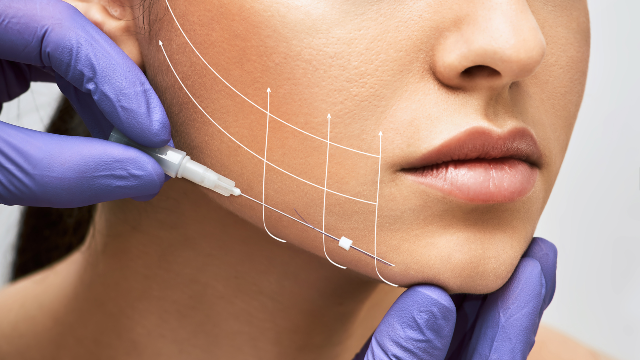
Threads produce a change by physical repositioning. The effect exists as soon as the placement is done, which is why the record can describe it as immediate.
Energy treatments produce a change by heating tissue in a controlled way, which prompts collagen contraction and then new collagen production. Contraction can give an early tightening sensation; the substantial part arrives over weeks.
So the honest framing is:
Threads: the result is on the day, and the following days are swelling and bruising obscuring it.
Energy: the day gives you little, and the result arrives after you have gone home.
For a patient travelling from the Singapore, that second line has a blunt consequence worth confronting early. If your reason for choosing Korea is to see a change while you are there, only one of these two categories is describing that.
What each one asks of you
The costs are real and they are different in kind rather than in size.
Thread lifting asks for local anaesthesia Across this clinic's facial menu, almost everything else uses cream or nothing. That difference marks the threshold between a session and a procedure.
Thread lifting names bruising first among its after-effects, along with swelling, and states a recovery period of about one to two days. It also asks you not to sleep face-down afterwards and to take care washing your face.
Energy lifting asks for numbing cream and, generally, less. Recovery figures across the clinic's energy options range from same-day return to about a day for most, with redness, warmth or tenderness named rather than bruising.
Energy lifting asks you to wait. Which is a cost, even though it does not appear on any recovery line.
Neither list makes one category better. They price differently.
Durability: closer than the categories suggest
A common assumption is that a placement lasts longer than a heating treatment. The published figures do not support that as a rule.
Thread lifting: a stated maintenance and retreatment window of six to nine months.
Energy lifting at this clinic: anywhere from about one to two months at the short end to about six to twelve months at the long end, depending entirely on which treatment.
So the thread figure sits inside the energy range rather than above it. A patient choosing purely on durability would not be choosing a category — they would be choosing a specific treatment, and some of the energy options match or exceed the thread window.
Which is one of the more useful things this comparison can tell you: "threads last longer" is not what these records say.
Risk profiles differ in kind
Not in severity — in type, and the distinction is worth understanding.
Energy treatments' named effects are the ones you would expect from controlled heating: redness, warmth, tenderness, swelling, sensitivity. Less common possibilities across the clinic's ultrasound options include burns, altered sensation and nerve-related effects.
Thread lifting's record names bruising and swelling, and adds items that only apply when something is placed and remains: the clinic's eye-area thread treatment names thread visibility or displacement, asymmetry and prolonged inflammation among its less common complications.
The general point: a treatment that leaves something behind has a category of complication that a treatment depositing energy does not. That is not an argument against it. It is a reason the questions differ — for threads, "what would you do if that happened?" is a real question with a real answer, and it is better asked before the procedure than after a flight home.
The National Library of Medicine's overviews of anaesthesia, bruises and wounds and injuries cover the background for the placement side; ultrasound and skin ageing for the energy side.
The exclusion lists ask about different things
Worth noticing, because the questions are not the same and only one of them is about your skin.
Thread lifting's exclusions are built around healing: certain skin infections, significant inflammation, bleeding problems, and medical conditions affecting healing.
Energy lifting's exclusions are built around what the energy interacts with: active infection or inflammation, and — for several treatments — implanted electronic devices, metal implants in the treatment field, or pregnancy.
So the first question to answer honestly about yourself is: do I have anything that affects bleeding or healing, and do I have anything implanted? Those two questions point in different directions, and either can settle this comparison before any preference does.
Never stop a prescribed medication on your own in order to qualify for a cosmetic treatment. That decision belongs to whoever prescribed it — the National Library of Medicine's guidance on drug safety and blood thinners covers the general principle, and the clinic will want the full list either way.
A decision sequence, in the order that actually works
Not a table. Four questions, answered in this order, each of which can end the comparison.
One: is anything about my health incompatible with one of them? Bleeding, healing, implants. Ask this first because it is the only question with a hard answer.
Two: when do I need to see something? If the honest answer is "before I fly home," only one category is describing that. If the honest answer is "in a few months," both are open.
Three: what is my concern, and where is it? Threads are described for facial contours and sagging. Energy treatments span a wider set of findings, including surface quality and firmness, which are not what a thread addresses.
Four: how much interruption can my week absorb? Bruising in a visible place has its own timetable and does not consult your itinerary.
Only after those four does the mechanism conversation matter — and by then it is the clinic's to have, not yours. Its published approach selects treatment after assessing the individual rather than by device, as set out on its about page.
The question the comparison usually gets wrong
"Which is better?" has no answer in these records and this article will not pretend otherwise.
What the records support is narrower and more useful: these two categories are aimed at different moments in a patient's plan, and the honest conversation is about which moment you are in.
There is also a third possibility that comparison articles routinely omit, so it is stated here: the assessment may recommend neither. The clinic's published position includes avoiding unnecessary treatment, and a finding that is volume loss rather than laxity, or pigment rather than position, belongs to an entirely different part of the menu.
Arriving prepared to be told that is a better preparation than arriving having picked a side.
What neither record contains
No comparative outcome data. Nothing published compares these categories at this clinic.
No thread specification. Material, type and count are not in the record for the facial thread treatment. Ask.
No energy settings for any of the energy options.
No success or complication rates for either category. The clinic publishes a before-and-after gallery and a patient review section — its own materials, useful for what is aimed at rather than for what you should expect.
Four gaps, all of which are consultation questions, and the conversation can be opened before you fly through the clinic's contact page, with English-language support on weekdays, 09:30 to 19:00. The National Library of Medicine's guidance on evaluating health information is the right frame for any page that fills those gaps confidently.
What the comparison looks like from the clinic's side
A useful shift of perspective, because it explains why this article cannot end with a recommendation.
From where you sit, the question is which category to choose. From where a clinician sits after examining a face, the question is different: what is the finding, how much tissue is there, where has it moved, and what will hold.
Those are not answerable from a description of your concern, which is why the published approach at this clinic puts assessment before selection and why its material contrasts individualised assessment with device-only selection.
There is a version of this that patients can act on, though, and it is worth stating: the more precisely you describe what changed, the better the assessment works. "The line from my mouth to my chin deepened over about two years, and it is worse on the left" gives a clinician three facts. "I want a thread lift" gives them a request to either grant or argue with.
One thing to settle before either
Regardless of which category you end up in, settle the follow-up before you leave the building.
Which channel applies to you. Roughly how quickly a reply arrives. What would count as urgent enough not to wait for one. And, for a placement treatment specifically, what was placed and where.
The clinic states that it operates a feedback channel after treatment with English-language aftercare and remote follow-up consultation. That is worth converting into specifics while you are still in the room, because a general assurance is not something you can act on at two in the morning in a different time zone.
The Bottom Line
- The timing difference is the real distinction: threads are described as producing an immediate lifting effect, while energy treatments develop as collagen responds over the following weeks.
- Thread lifting uses local anaesthesia and names bruising first, with a stated one-to-two-day recovery; energy options generally use cream or nothing and name redness and warmth.
- "Threads last longer" is not what these records say — the thread window of six to nine months sits inside the range published across the clinic's energy treatments.
- The exclusion lists ask different questions: bleeding and healing for threads, implants and energy contraindications for the rest. Either can settle the comparison first.
- A treatment that leaves something behind carries complications a heating treatment does not, so "what would you do if that happened?" is worth asking before the procedure.
Frequently Asked Questions
Which one works faster?
Thread lifting is described as producing an immediate lifting effect. Energy-based lifting develops over the following weeks as collagen responds.
Which lasts longer?
Thread lifting states six to nine months. The clinic's energy treatments range from about one to two months up to six to twelve, so it depends which energy treatment is being compared.
Which has more downtime?
Thread lifting states about one to two days and names bruising and swelling. Most of the clinic's energy options describe same-day to one-day recovery with redness or warmth.
Which is more invasive?
Thread lifting. It uses local anaesthesia rather than cream and places threads that remain, which is why its complication list includes items the energy treatments do not have.
Can they be combined?
That is a clinical question for the consultation. The clinic's published approach assesses the individual before selecting treatment.
Which should I choose if I am only in Korea for a week?
If seeing a change before you fly home matters, only the thread category describes that. If you can wait for a result to develop, both remain open — but say your travel window at the consultation either way.
Does a bleeding disorder rule out threads?
Bleeding problems and conditions affecting healing appear among thread lifting's exclusions. Disclose them before travelling, and never stop a prescribed medication on your own.
Is either a substitute for a facelift?
Neither record makes that claim, and this article does not either.
This article is for general informational purposes and does not constitute individualised medical advice. It is not a self-diagnosis tool. Treatment results may vary depending on individual conditions, skin characteristics, and treatment plans, and whether a procedure is appropriate for you can only be determined through a consultation with a qualified dermatologist or other appropriately qualified clinician who has examined you in person.
More Articles
Continue reading our clinical guides.