Physician-Led Non-Surgical Lifting & Aesthetic Medicine in Gangnam, Seoul
4.8 Google Rating (56 Reviews)
en-SG

Facial Lifting & Skin Tightening · Needs Clinic Confirmation
Ulthera HIFU Lifting
Ulthera uses high-intensity focused ultrasound energy to target specific depths, including the SMAS layer, helping to tighten and lift sagging skin and stimulate collagen regeneration.
Schedule a ConsultationUlthera HIFU Lifting
Medically reviewed by Dr Jin-Woo Doh, Representative Director, JD Clinic, Gangnam, Seoul
Ulthera uses high-intensity focused ultrasound energy to target specific depths, including the SMAS layer, helping to tighten and lift sagging skin and stimulate collagen regeneration. At JD Clinic in Gangnam, Seoul, it is the deep-layer option in the facial lifting and skin tightening menu, the treatment chosen when the concern is structural support rather than surface quality. Patients travelling from overseas request it to lift sagging skin, restore elasticity, sharpen facial contour lines and refine skin texture without invasive surgery.
JD Clinic's doctor mapping is recorded at the speciality level, so this page names the doctors who direct care for this treatment area rather than claiming that one named doctor personally carries out every individual session.
What Is Ulthera HIFU Lifting?
Ulthera HIFU lifting delivers focused ultrasound energy to chosen depths beneath the skin, including the SMAS, the fibromuscular layer surgeons address in a facelift, so that the tissue responds by contracting and producing new collagen.
The depth is the point. Energy is deposited at a chosen level rather than spread through the surface, which is why the treatment is aimed at structural laxity.
The SMAS layer is examined before treatment, not assumed.
Real-time imaging is used. DeepSEE provides real-time confirmation of where the ultrasound energy is going.
The session has a set shape. About twenty minutes of topical numbing, then approximately sixty minutes of treatment.
Change continues after you leave. An immediate tightening effect may be noticed, with collagen regeneration continuing over roughly one to two months.
The clinic's approved claim wording for this treatment is specific about where it belongs: lifting lax or loose skin on the submental region under the chin and on the neck, lifting lax skin on the eyebrow and brow, and improving lines and wrinkles on the décolletage. That is a narrower list than "lifting the face", and it is the honest one.
Who Performs Ulthera HIFU Lifting at JD Clinic

Dr Jin-Woo Doh
Representative Director of JD Clinic
Care in this treatment area is directed by Dr Jin-Woo Doh, Representative Director of JD Clinic, who graduated from Seoul National University College of Medicine and serves as a Guest Professor at Seoul National University Hospital. Non-surgical facial lifting and anti-ageing is the first of his listed core specialisations.
The clinic's stated technique for this treatment is a four-part sequence: individual skin assessment, custom design of the areas to be lifted, real-time imaging verification with DeepSEE, and precise energy delivery to the SMAS layer. The imaging step is what distinguishes a planned treatment from a patterned one. The operator sees the layer before placing energy in it rather than working from an average anatomy.
He is a full member of the Korean Society of Aesthetic Surgery, the Korean Society of Aesthetic Plastic Surgery, the International Society of Aesthetic Surgery, the Korean Society for Obesity Treatment, and the Korean Society of Aesthetic Plastic Surgery and Laser. JD Clinic has not provided licence or board-status records for this page, so none is claimed here.
JD Clinic describes its approach as assessing skin thickness, the degree of laxity and facial structure before selecting a device, then targeting the intended tissue layer with the minimum number of passes needed rather than applying one fixed setting to every patient.
Who Is a Good Candidate for Ulthera HIFU Lifting?
Adults with sagging skin and a loss of structural elasticity
People whose facial contour lines have blurred rather than simply creased
Those with unrefined skin texture alongside laxity
Anyone wanting natural-looking facial rejuvenation without surgery
Patients whose concern sits under the chin, along the neck, at the brow, or on the décolletage, which are the areas this treatment's approved claims cover
Ulthera HIFU lifting should generally be avoided or postponed for:
Individuals with open skin wounds, active local skin infection or inflammation
Anyone with embedded metallic or electronic implants around the treatment area
Patients who are pregnant or breastfeeding
Anyone who has recently had facial surgery, threads, fillers or other energy-based treatments
That last exclusion matters more than it sounds. Recent work in the same tissue changes what a focused ultrasound treatment is being applied to, so the interval since a previous procedure is a genuine question at consultation rather than a formality. Threads and fillers in particular occupy the layers this treatment heats, and the sensible sequence between them is a clinical judgement about both timing and depth. Bring dates rather than approximations if you can, as "a few months ago" and "six weeks ago" lead to different decisions.
It is also worth being clear with yourself about what kind of change you have noticed. Where a contour has softened and the skin along the jaw or under the chin has begun to hang, focused ultrasound at depth is a reasonable thing to discuss. Where the complaint is surface quality, such as dullness, fine texture or pore appearance, this is the wrong depth for it, and a consultation that says so is doing its job.
What to Expect: Procedure, Recovery, and Results Timeline
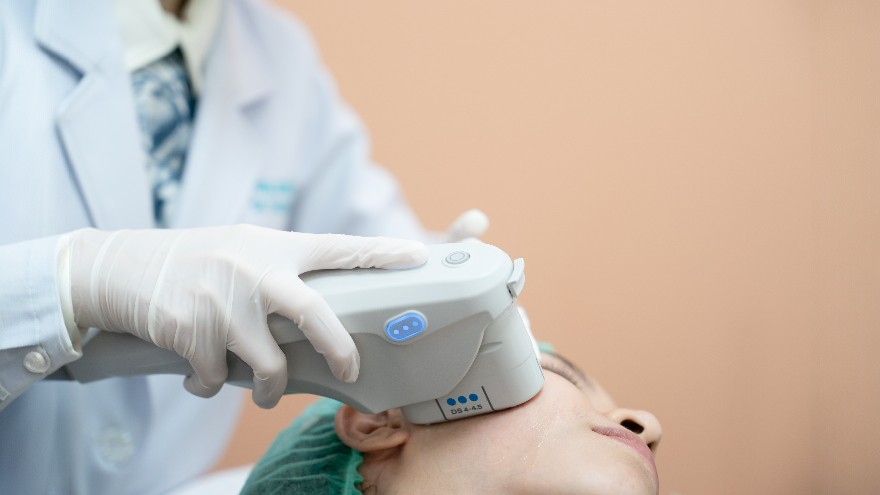
Treatment starts with a thorough analysis of the individual's skin condition, followed by a custom design of the areas that need lifting. A real-time ultrasound imaging check with DeepSEE precedes precise energy delivery to the SMAS layer.
Topical numbing cream is applied for approximately twenty minutes beforehand. During the ultrasound delivery, patients may feel mild discomfort or a prickling heat. The numbing cream is what keeps that at a manageable level rather than removing it entirely.
Stage | What happens | Timing |
|---|---|---|
Skin and structure analysis | Individual assessment, area design | Start of visit |
Numbing | Topical anaesthetic cream | Approximately 20 minutes |
Imaging check | DeepSEE real-time verification | Before and during delivery |
Treatment | Focused ultrasound to the SMAS layer | Approximately 60 minutes |
Same day | Return to normal daily activity | Immediately |
Early weeks | Collagen regeneration continues | About 1–2 months |
Result | Stated duration | Approximately 6–12 months |
Retreatment | Typical cycle | About one year |
Recovery is immediate in the practical sense, as patients resume normal daily activities right after the session without explicit downtime. Temporary mild swelling or slight tenderness may follow. Less commonly, there can be prolonged localised swelling, slight bruising, or mild temporary tenderness in the treated areas.
Preparation: clean the skin thoroughly before treatment, make sure there are no active inflammatory skin conditions in the target zones, and tell the doctor about any active skin conditions. Avoid harsh chemical peels, aggressive facial scrubs and active skin irritants immediately before the session. Afterwards, monitor the temporary swelling, avoid extreme temperature exposure such as saunas, and keep to basic daily skincare and sun protection.
Non-invasive ultrasound lifting requires no prolonged downtime, so a stay of one to two days covers consultation and treatment, and patients can board a flight home on the same day or the day immediately after. The clinic operates a 24-hour post-treatment feedback system, and English-language aftercare is available through remote follow-up consultation and ongoing channels such as email and messaging once a patient has returned home.
Combining Ulthera HIFU Lifting with Other Treatments
Ulthera can be combined with radiofrequency tightening devices or thread lifting procedures to address the deep SMAS layer and the more superficial skin layers at the same time. That is the clinic's stated rationale for combining, and it is a coherent one: the treatments are not duplicating each other, as they work at different depths.
Radiofrequency tightening addresses the dermis while focused ultrasound addresses the SMAS
Thread lifting repositions tissue mechanically where energy alone will not
Sequencing and interval are decided by the doctor, not by what fits into one visit
Alternatives include monopolar radiofrequency skin tightening platforms and micro-needle radiofrequency systems that target dermal layers. Which is right depends on where the laxity sits. More about the clinic and its team is on the JD Clinic about page.
Safety, Precision, and Clinic Standards
JD Clinic has been registered since 2023 as a Registered Medical Institution for Attracting Foreign Patients, certified by the Ministry of Health and Welfare in compliance with the Medical Overseas Expansion and Foreign Patients Attraction Act. The clinic's business registration number is 530-11-00701.
The clinic's stated quality-control process is individualised medical assessment rather than device-led selection, with treatment that is not needed avoided rather than added. Consultation and treatment are doctor-led. For this treatment specifically, the clinic states that it assesses skin condition and facial structure, customises the treatment areas, uses DeepSEE for real-time confirmation of the ultrasound energy, and examines the SMAS layer precisely before treatment.
The independent picture of focused ultrasound as a category is consistent with that caution. The American Society for Dermatologic Surgery describes focused ultrasound therapy as depositing ultrasound energy below the skin surface to stimulate new collagen formation, applied to areas including the brow, and associated with temporary redness, swelling, tingling, tenderness, bruising or numbness. Its wider account of non-invasive skin tightening adds burns, infection, numbness and contour change as uncommon effects across the category. The UK Department of Health and Social Care, consulting on licensing non-surgical cosmetic procedures in England, describes high-intensity focused ultrasound as directing energy to layers deep underneath the skin to encourage contraction and lifting, and radiofrequency as using heat from radio waves to cause controlled tissue damage, which is the reason both sit inside a proposed licensing regime.
On expectations, the American Academy of Dermatology describes non-invasive skin tightening as producing gradual, modest lifting rather than surgical results, with ultrasound and radiofrequency changes typically developing over roughly two to six months.
English-language support is provided by a dedicated international patient coordinator, Cheon Seung-yeon, Team Manager, on weekdays from 09:30 to 19:00, with Korean and Japanese coordination also available.
The Bottom Line
Ulthera places focused ultrasound at chosen depths including the SMAS layer, with real-time imaging verification.
The approved claims cover the submental area and neck, the brow, and lines on the décolletage.
About twenty minutes of numbing and sixty minutes of treatment, with no explicit downtime afterwards.
Immediate tightening may be felt, with collagen change over one to two months and results stated at six to twelve.
Recent facial surgery, threads, fillers or other energy treatments are a reason to wait, not a detail.
Frequently Asked Questions
Who is a good candidate for Ulthera HIFU lifting?
People with sagging skin, a loss of structural elasticity, unrefined facial contours or rough skin texture who want natural lifting without surgery. Because the energy is placed deep rather than at the surface, the treatment suits laxity that has changed the shape of a contour more than it suits a single fine line.
Who should avoid or postpone this treatment?
Anyone who is pregnant or breastfeeding, anyone with active skin infection, wounds or inflammation in the area, and anyone with certain implanted electrical devices or metal implants there. It should also be postponed after recent facial surgery, thread lifting, fillers or other energy-based treatments. Say when those were done, not just that they were.
How long does it take, and is it painful?
About twenty minutes of topical numbing followed by approximately sixty minutes of treatment. During the ultrasound delivery, you may feel mild discomfort or a prickling heat. The numbing cream applied beforehand is what keeps that within a manageable range, and the sensation varies with the depth being treated.
What does DeepSEE actually do?
It provides real-time confirmation of where the ultrasound energy is being delivered, and the clinic states that the SMAS layer is examined before treatment begins. In practical terms, it means the operator is looking at your anatomy rather than working from a standard map. This is relevant because the depth that is right for one face is not automatically right for another.
How long should I stay in Korea, and when can I fly?
A stay of one to two days is generally enough for consultation and treatment, since non-invasive ultrasound lifting requires no prolonged downtime. Patients can board a flight home the same day or the day immediately after the session.
When will I see results, and how long do they last?
An immediate tightening effect may be noticed. Collagen regeneration then continues for approximately one to two months, during which a more natural lifting effect develops. The clinic states results lasting approximately six to twelve months, with a retreatment cycle of about a year.
What are the common side effects and the less common risks?
Temporary mild swelling or minor skin sensitivity is the common experience, and it settles quickly. Uncommonly, there can be prolonged localised swelling, slight bruising, or mild temporary tenderness in the treated areas. Because energy is being placed deep, anything sharp, persistent or asymmetric is worth reporting rather than watching.
Does JD Clinic publish a price for Ulthera HIFU lifting?
JD Clinic does not publish treatment prices for this market; a quotation is given after an individual consultation. For a depth-based treatment, what is actually being decided at consultation is the area and the energy plan, and the quotation follows that.
Book a Consultation at JD Clinic
If the change you have noticed is in the shape of your jaw or neck rather than in the surface of your skin, focused ultrasound is one of the options a consultation will weigh. JD Clinic is located at B2, 616 Gangnam-daero, Gangnam-gu, Seoul, Republic of Korea, and can be reached on +82-2-523-7581 or through the clinic's contact page. Consultations run Monday to Thursday from 09:30 to 19:00, Friday until 21:00 and Saturday until 16:00, with a lunch break on weekdays from 13:00 to 14:00.
International patients can start with an online enquiry through the JD Clinic contact page, and an English-speaking coordinator will follow up.
Disclaimer
This page is for general information only and is not medical advice, a diagnosis, or a treatment recommendation. Outcomes differ from person to person, and whether any treatment is appropriate for you can only be decided in a consultation with a qualified doctor.
Sources & Further Reading
Ultrasound Therapy for Sagging Skin — American Society for Dermatologic Surgery
Non-invasive Skin Tightening Treatments — American Society for Dermatologic Surgery
Many ways to firm sagging skin — American Academy of Dermatology
The licensing of non-surgical cosmetic procedures in England: consultation document — UK Department of Health and Social Care
Thread Lift Risks and Safety — American Society of Plastic Surgeons
Other Services
Explore additional treatments offered at JD Clinic.