Physician-Led Non-Surgical Lifting & Aesthetic Medicine in Gangnam, Seoul
4.8 Google Rating (56 Reviews)
en-US


Facial Lifting & Skin Tightening · Needs Clinic Confirmation
Pangyes Needle-Free Infusion
Pangyes Needle-Free Infusion is a delivery method rather than a treatment in its own right: at JD Clinic in Gangnam, Seoul the device uses a fine 34G needle to enter the skin, sprays a selected drug or solution, and applies high positive pressure to help carry it in.
Schedule a ConsultationPangyes Needle-Free Infusion

Medically reviewed by Dr. Jin-Woo Doh, Representative Director, JD Clinic, Gangnam, Seoul
Pangyes Needle-Free Infusion is a delivery method rather than a treatment in its own right: at JD Clinic in Gangnam, Seoul the device uses a fine 34G needle to enter the skin, sprays a selected drug or solution, and applies high positive pressure to help carry it in. What it achieves therefore depends less on the device than on what is being delivered and why — which is the single most useful thing to understand before booking it.
JD Clinic's doctor mapping is recorded at the specialty level, so this page names the doctors who direct care for this treatment area rather than claiming that one named doctor personally carries out every individual session.
What Is Pangyes Needle-Free Infusion?
The clinic's description of the mechanism is specific, and it is worth reading literally.
A fine 34G needle enters the skin.
The selected drug or solution is sprayed.
High positive pressure then helps carry it into the skin.
No anaesthesia is required, and the procedure is designed for almost no pain.
The session is short. Within ten minutes, with daily activities resumed the same day.
The name says "needle-free", and the clinic's own procedure record describes a 34G needle. Both can be true of a device that uses an extremely fine needle rather than a conventional injection, but the wording is worth clarifying at consultation rather than assumed — particularly for anyone whose reason for choosing it is a needle phobia.
Who Performs Pangyes Needle-Free Infusion at JD Clinic

Dr. Jin-Woo Doh
Representative Director of JD Clinic
Care in this treatment area is directed by Dr. Jin-Woo Doh, Representative Director of JD Clinic, who graduated from Seoul National University College of Medicine and serves as a Guest Professor at Seoul National University Hospital. Non-surgical facial lifting and anti-aging is the first of his listed core specializations.
Before treatment the provider reviews medical history, medications, allergies, skin condition and treatment goals, and selects the appropriate solution and decides whether the procedure is suitable. For a delivery device, that selection is the clinical decision — the device does not determine what goes into the skin, the assessment does.
He is a full member of the Korean Society of Aesthetic Surgery, the Korean Society of Aesthetic Plastic Surgery, the International Society of Aesthetic Surgery, the Korean Society for Obesity Treatment, and the Korean Society of Aesthetic Plastic Surgery and Laser. JD Clinic has not provided licence or board-status records for this page, so none is claimed here.
JD Clinic describes its approach as assessing skin thickness, the degree of laxity and facial structure before selecting a device, then targeting the intended tissue layer with the minimum number of passes needed rather than applying one fixed setting to every patient.
Who Is a Good Candidate for Pangyes Needle-Free Infusion?
People who need a selected drug or solution delivered into the skin in a specific area
Those who prefer a minimally invasive approach to that delivery
Patients looking for a short procedure with no interruption to the day
Treatment may need to be postponed or avoided for:
Anyone with an allergy or contraindication to the intended medication or solution
People with an active skin infection at the treatment area
Those with significant irritation or another condition affecting the area
Patients with certain medical conditions, on individual assessment
Suitability depends on the substance being administered as much as on the skin. That is the unusual thing about this treatment compared with the devices elsewhere on this menu: the allergy question is not a formality, because the reaction that matters may be to what is delivered rather than to the delivery.
What to Expect: Procedure, Recovery, and Results Timeline
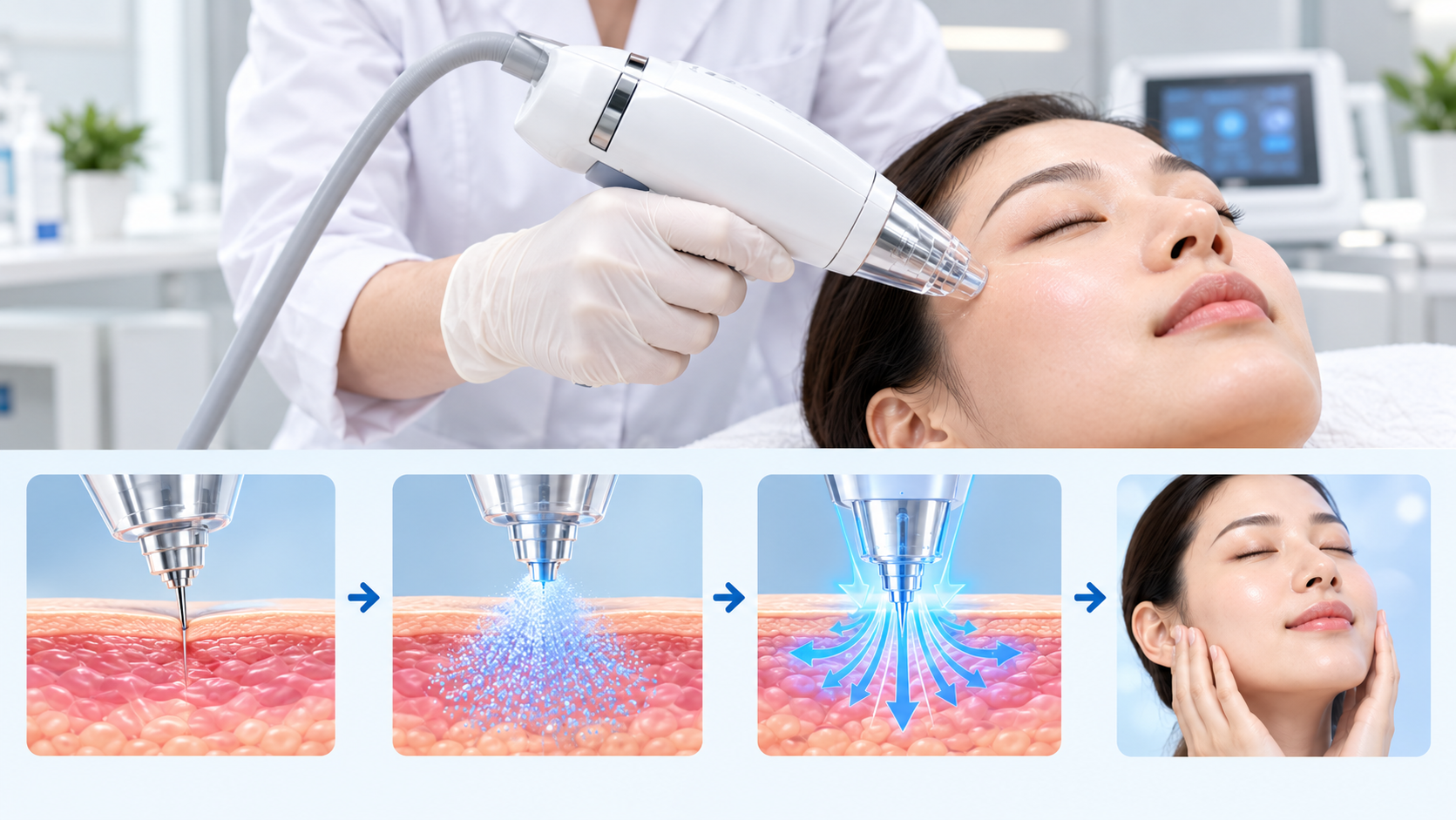
The device punctures the skin with the fine 34G needle, sprays the selected drug or solution, and then applies high positive pressure to facilitate delivery into the skin.
Stage | What happens | Timing |
|---|---|---|
Consultation | History, medications, allergies, skin condition, goals | Solution selected here |
Treatment | 34G needle, spray, positive-pressure delivery | Within 10 minutes |
Anaesthesia | Not required | — |
Same day | Daily activities resumed | Immediately |
Early effects | Redness, mild swelling, tenderness or irritation | Temporary |
Maintenance | Stated period | 1–2 months |
Retreatment | Stated cycle | Monthly |
Possible effects include temporary redness, swelling, tenderness, irritation, bruising or discomfort at the treatment area — and reactions can also depend on the specific drug or solution used, which is the variable this page cannot generalise about.
Before treatment, follow the provider's instructions on medications, skincare products and preparing the area, keep the treatment area clean, and disclose allergies, medications, medical conditions and any active skin problem. Avoid irritating skincare products or procedures that would leave the area sensitive beforehand, and confirm any medication-related restriction at consultation. Afterwards, the clinic's guidance is to focus on moisturising and soothing the skin and to protect the treated area thoroughly from ultraviolet exposure.
Because the procedure is completed within ten minutes and daily activities resume the same day, an extended stay is generally not expected, though individual arrangements vary. Travel may be possible afterwards if there are no individual concerns — the clinic's own wording asks that flight timing be confirmed with a medical professional rather than assumed. The clinic operates a 24-hour post-treatment feedback system, and English-language aftercare is available through remote follow-up consultation and ongoing channels such as email and messaging once a patient has returned home.
Combining Pangyes Needle-Free Infusion with Other Treatments
The clinic's records do not state a combination protocol for this treatment, so this page does not describe one. In practice a delivery method is often used alongside something else rather than on its own, and what it is paired with is a clinical decision that depends on the solution selected.
Depending on the goal, alternatives include conventional topical application, conventional injection, mesotherapy, or another device-assisted delivery method. Each places the substance at a different depth and with different precision, which is the real basis for choosing between them. More about the clinic and its team is on the JD Clinic about page.
Safety, Precision, and Clinic Standards
JD Clinic has been registered since 2023 as a Registered Medical Institution for Attracting Foreign Patients, certified by the Ministry of Health and Welfare in compliance with the Medical Overseas Expansion and Foreign Patients Attraction Act. The clinic's business registration number is 530-11-00701.
The clinic's stated quality-control process is individualised medical assessment rather than device-led selection, with treatment that is not needed avoided rather than added. Consultation and treatment are physician-led.
The possible risks here are skin irritation, inflammation, infection, bruising, or an adverse reaction to the administered substance, and individual risk depends on the treatment material and the skin condition. That last clause is the one that carries the weight: whatever is delivered has its own profile, and it is entirely reasonable to ask for the substance to be named and for its risks to be explained before agreeing to the procedure.
Two independent points belong on any page about delivering a substance into skin. The Centers for Disease Control and Prevention notes that cosmetic procedures are among the settings where unsafe injection practices occur, and that reusing needles or syringes or mishandling medication vials can transmit hepatitis B, hepatitis C, bacterial and fungal infections and possibly HIV. The American Academy of Dermatology advises anyone considering a cosmetic treatment to establish who will perform it, ask about their experience with that specific procedure, and discuss the risks and the realistic expected result before agreeing to anything.
Separately, and relevant to the "needle-free" framing: both the American Academy of Dermatology and the American Society for Dermatologic Surgery warn specifically against pressure-driven, needle-free devices used to force filler into the skin, which have caused permanent damage to skin, lips and eyes, blocked blood vessels, tissue death and in some cases stroke. That warning is about a different class of product and a different use, but it is the reason the mechanics of any pressure-based delivery are worth understanding rather than taking on trust.
English-language support is provided by a dedicated international patient coordinator, Cheon Seung-yeon, Team Manager, on weekdays from 09:30 to 19:00, with Korean and Japanese coordination also available.
The Bottom Line
This is a delivery method: a 34G needle, a sprayed solution, and positive pressure to carry it in.
What it achieves depends on the solution selected at consultation, not on the device.
Under ten minutes, no anaesthesia, daily activities the same day.
Maintenance is stated at one to two months, with monthly retreatment.
Ask what is being delivered and why — the allergy question here is about the substance, not the device.
Frequently Asked Questions
Who is a good candidate for this treatment?
People who need a medication or solution delivered into the skin in a specific area and prefer a minimally invasive route. Suitability depends on the substance being administered and on the individual's skin condition, so the answer is really about what is being delivered rather than about the device.
Who should avoid or postpone treatment?
Anyone with an allergy or contraindication to the intended medication or solution, anyone with an active skin infection at the treatment area, and anyone with significant irritation or another condition affecting it. A medical assessment before treatment is recommended.
How long does it take, and is it painful?
The procedure takes within ten minutes. The device is designed to enter the skin with a 34G fine needle and deliver the solution with almost no pain. No anaesthesia is used, and the clinic's records do not specify one for this treatment.
Is it really needle-free?
The service name says needle-free, and the clinic's own procedure record describes a fine 34G needle used to enter the skin before the solution is sprayed and pressure applied. Both descriptions can describe the same device, but if avoiding a needle is your reason for choosing it, ask the clinic to explain the mechanism directly.
How long should I stay in Korea, and when can I fly home?
Since the procedure takes under ten minutes and daily activities resume the same day, an extended stay is generally not expected. Travel may be possible afterwards if there are no individual concerns, and the clinic asks that flight timing be confirmed with a medical professional.
When will I see results?
The clinic's records do not state a results timeline for this treatment, and this page does not invent one — what it can offer is the maintenance rhythm: approximately one to two months, with retreatment at monthly intervals. What you should expect to see, and when, depends on the solution being delivered and is a question for the consultation.
What are the common side effects and the risks?
Temporary redness, mild swelling, tenderness or irritation after the procedure. Possible risks include skin irritation, inflammation, infection, bruising, or an adverse reaction to the substance administered — and that last one depends entirely on what has been chosen for you.
Does JD Clinic publish a price for this treatment?
JD Clinic does not publish treatment prices for this market; a quotation is given after an individual consultation. Because the solution is selected at consultation, there is no single item to price in advance.
Book a Consultation at JD Clinic
If a clinician has suggested delivering something into the skin of a specific area, this is one of the ways of doing it — and the consultation is where the what and the why get settled. JD Clinic is located at B2, 616 Gangnam-daero, Gangnam-gu, Seoul, Republic of Korea, and can be reached on +82-2-523-7581 or through the clinic's contact page. Consultations run Monday to Thursday from 09:30 to 19:00, Friday until 21:00 and Saturday until 16:00, with a lunch break on weekdays from 13:00 to 14:00.
International patients can start with an online enquiry through the JD Clinic contact page, and an English-speaking coordinator will follow up.
Disclaimer
This page is for general information only and is not medical advice, a diagnosis, or a treatment recommendation. Outcomes differ from person to person, and whether any treatment is appropriate for you can only be decided in a consultation with a qualified doctor.
Sources & Further Reading
Safe Injection Practices and Your Health — Centers for Disease Control and Prevention
Best questions to ask when considering a cosmetic treatment — American Academy of Dermatology
Needle-free fillers: The risks you need to know about — American Academy of Dermatology
Injectables — American Society for Dermatologic Surgery
Other Services
Explore additional treatments offered at JD Clinic.